Social media OKRs (Objectives and Key Results) are a strategic planning framework designed for executives that tie social media activities directly to measurable business outcomes. Unlike traditional KPIs, this system translates social media vision into concrete targets, enabling brands to focus on high-level business results such as revenue, brand reputation, and market share.
What Are the Core Differences Between OKRs and KPIs?
Often confused in social media management, OKRs and KPIs serve different purposes. While KPIs (Key Performance Indicators) track the continuity of daily or weekly operational performance, OKRs define the desired direction and success.
Within an OKR framework, the "Objective" outlines the vision, while the "Key Results" measure the path to that goal in numerical terms. For example, increasing brand awareness is an objective, whereas raising the social media share of voice by 10 percent in the fourth quarter is a measurable key result.
Distinguishing Between Executive-Level and Team-Level Metrics
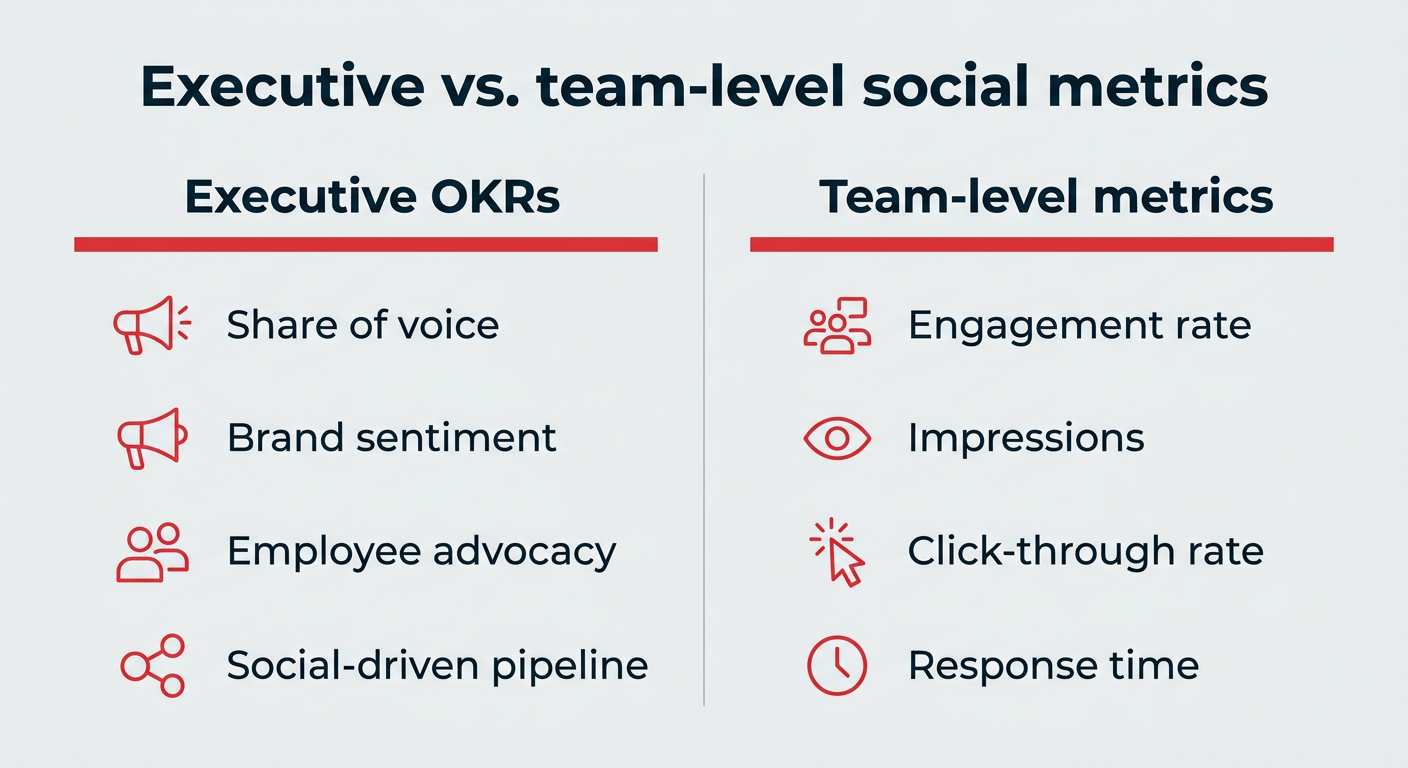
Senior executives want to link social media investments directly to business growth and reputation management. Therefore, executive-level OKRs generally focus on the following elements:
- Industry share of voice
- Brand sentiment analysis
- Employee advocacy participation and return on investment (ROI)
- Social-driven pipeline
In contrast, social media teams work with more tactical performance indicators on a daily and weekly basis. Engagement rates, impressions, click-through rates (CTR), and response times form the focus of operational teams. Executive leaders being active on social media triggers teams to develop visibility- and leadership-oriented OKRs, providing an organic contribution to brand pages.
Industry Reflections and Setting Achievable Goals
Effective OKRs are ambitious "stretch goals" structured with a success target of 60 to 70 percent. This framework prevents teams from settling for overly easy targets, creating a realistic and competitive growth space optimized on a quarterly basis. Integrating social media activities into budgets and income statements enhances the accuracy of strategic decisions for digital marketing professionals.
Frequently Asked Questions
How often should social media OKRs be reviewed and updated?
OKRs should generally be planned in three-month (quarterly) periods and revised periodically. This allows for rapid adaptation to changing market dynamics and campaign results.
How does personal executive activity on social media affect corporate OKRs?
Active participation by executives enables teams to construct new OKRs around thought leadership, personal visibility, and executive-focused content engagement; this indirectly supports the growth of main brand pages.
*This article was prepared based on data published by the Hootsuite Blog.
💬 Comments
No comments yet. Be the first!
You must be logged in to comment.
🔑 Log In